Most conversations about artificial intelligence still revolve around tools. People talk about ChatGPT, copilots, agents, automation platforms, and productivity gains. Those discussions matter — but they often miss the bigger question: what kind of company are we actually becoming?
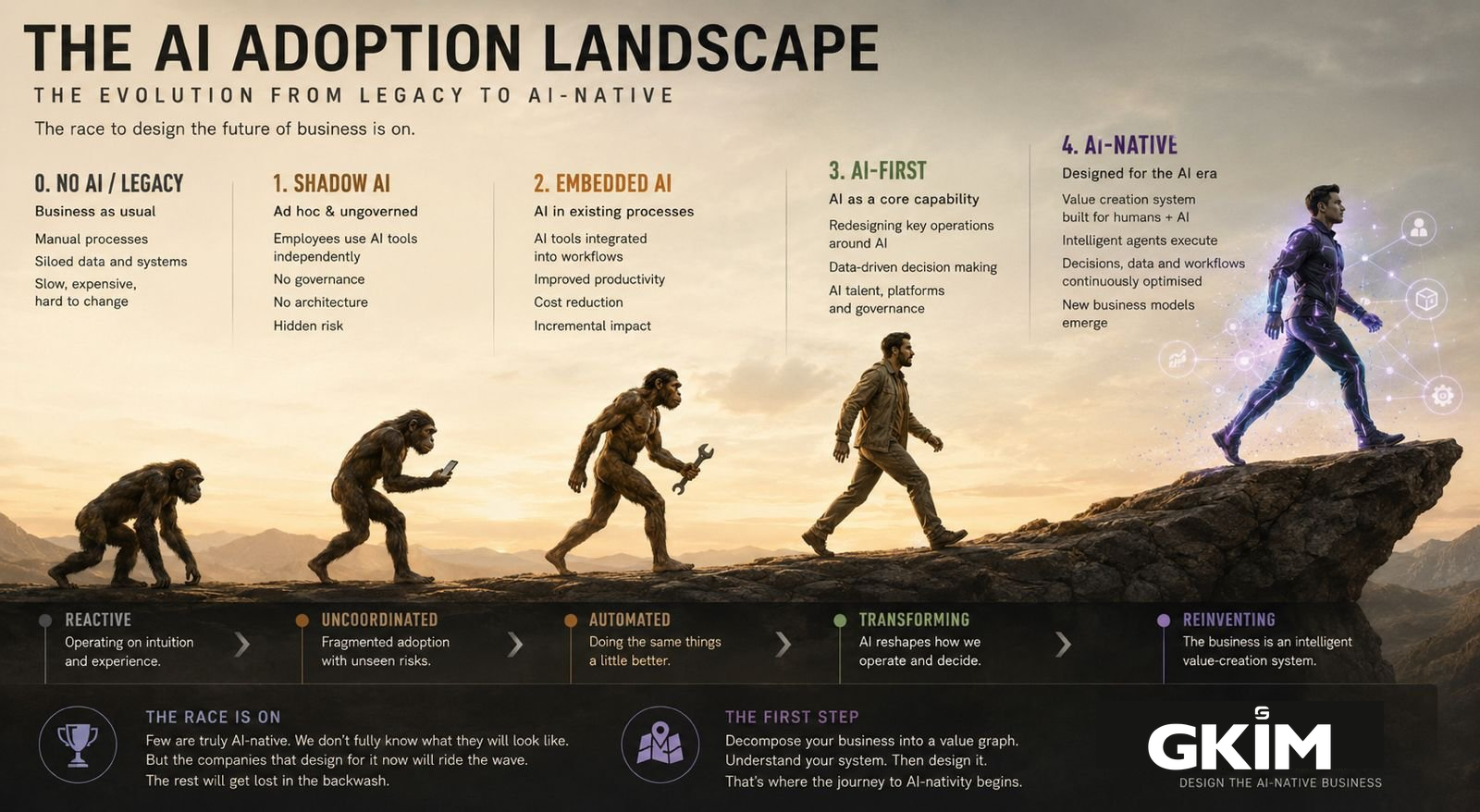
A useful way to think about the market is as a progression of maturity. The infographic above maps it visually. But let's work through what each stage actually means in practice.
-
Stage 0
Legacy / No AIManual processes, siloed data, slow and expensive to change. Business as usual.
-
Stage 1
Shadow AIEmployees use AI tools independently, without governance or architecture. Productivity gains exist, but so does hidden risk.
-
Stage 2
Embedded AIAI tools are deliberately integrated into existing workflows. Improved productivity and cost reduction — but still doing the same things a little better.
-
Stage 3
AI-FirstAI becomes a core capability. Key operations are redesigned around it. Data-driven decision-making, AI talent, platforms and governance all in place.
-
Stage 4
AI-NativeDesigned from the ground up for the AI era. Value creation is built for humans and AI together. Intelligent agents execute. New business models emerge.
Despite the growing use of the term, very few organisations today are genuinely AI-native. Many are AI-enabled. Some are AI-first. Almost none have fully reimagined themselves around the possibilities of intelligent systems.
The internet era provides a useful comparison. In the mid-1990s, very few people could have predicted the eventual shape of Amazon, Google, Airbnb, or Uber. We are at a similar point in the AI era today.
What seems increasingly certain is that tomorrow's winners will not simply automate existing businesses. They will redesign them.
The transition to AI-nativity is not primarily a technology challenge. It is a business design challenge.
An AI-native organisation is one where value creation itself has been intentionally structured so that humans and intelligent systems work together as a coherent operating model. Decisions, workflows, data flows, feedback loops, and customer interactions become part of an integrated system that can continuously learn and improve.
This raises an important question for every leadership team:
Most organisations struggle to answer this clearly. They can point to departments, software systems, reporting lines, and processes — but few possess an explicit model of how value is created, transferred, measured, and improved across the enterprise.
That is why we believe the journey toward AI-nativity begins with a value graph.
A value graph maps the customers, workers, partners, systems, decisions, information flows, and economic exchanges that make the business work. It turns an organisation from something people describe into something they can actually see, analyse, and improve.
Only once that system is visible can leaders begin asking the next-generation questions:
Which decisions should remain human?
Which activities can be delegated to agents?
Where does intelligence create the greatest leverage?
How should information flow?
What entirely new business models become possible?
This is the race now underway.
Not every organisation will become AI-native. Many will remain AI-assisted. Some will become AI-first. Others will find themselves competing against businesses designed specifically for an AI-accelerated world.
The challenge is no longer simply adopting AI.
The challenge is ensuring you are riding the wave rather than being caught in the backwash.
At GKIM, we believe the first step is not selecting an AI tool. It is understanding the business itself as a system. Once that system is visible as a value graph, it can be defined, designed, simulated, built, operated, and continuously evolved.
That is where the journey toward an AI-native business truly begins.